
Kent County Arrest Warrants Explained
A Kent County arrest warrant directs a peace officer to take a named person into custody and bring that person before a judge or magistrate. The process starts with a criminal complaint. A police agency or a prosecutor files it, and then a judge or magistrate reviews it for probable cause before signing anything. Michigan rules also let a court send a summons instead. So when a warrant is signed, the court usually had a reason to skip that gentler option.
Where the file lives depends on the charge. A misdemeanor or traffic case stays with the district court for that city or township. A felony moves to the 17th Circuit Court after bindover. That split matters for a warrant search, because one clerk's counter can come back empty while another docket is full, and only the issuing court can confirm what is active.
Note: An arrest warrant is issued by a court, so only that court can recall it, quash it, or change the bond attached to it.
Michigan's Complaint and Probable-Cause Review
Probable cause is a factual question in Kent County as anywhere else. The complaint must show why a reasonable person would believe an offense happened and that this person committed it, usually through a sworn affidavit, a police report number, and enough detail for the judge. Michigan Court Rule 6.102 governs the warrant-or-summons decision.
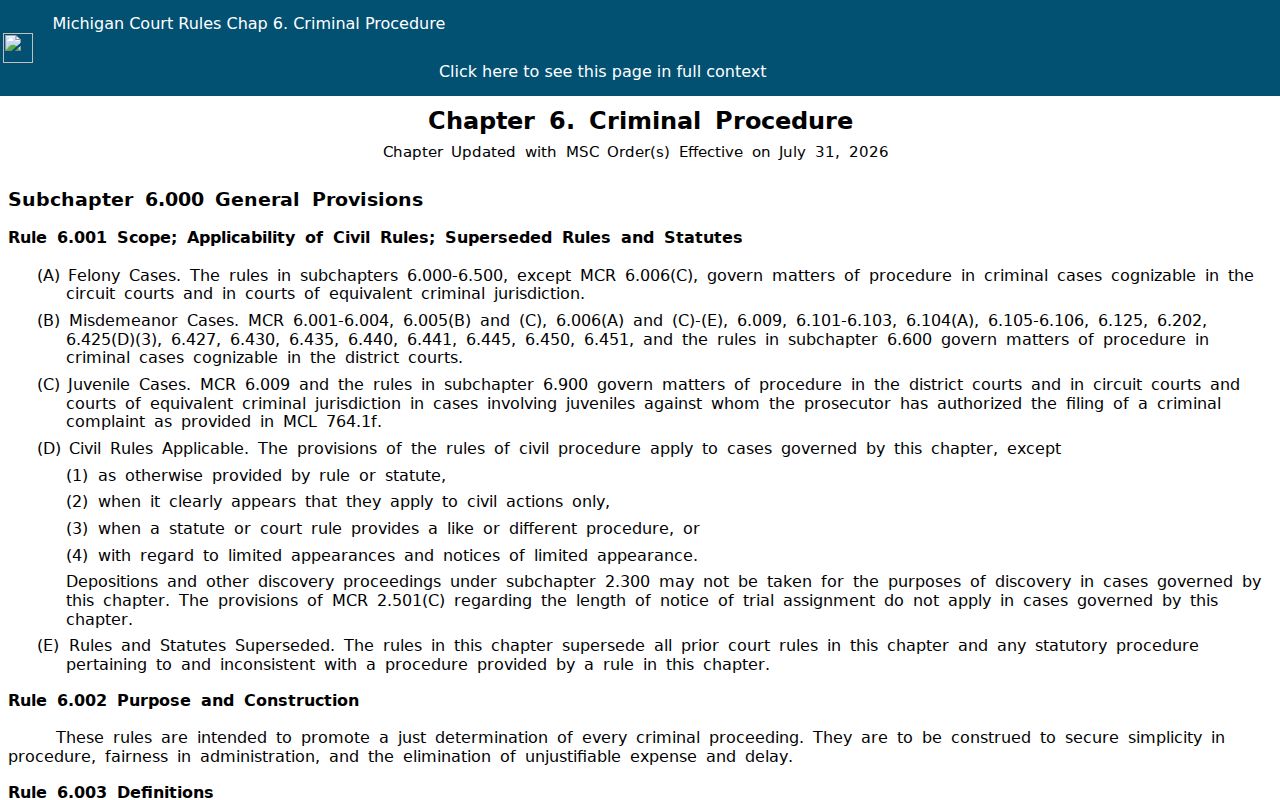
The court rules page above is the source for this issuance sequence. Kent County readers can also look at the SCAO MC 229 form. It shows the fields a warrant request carries: case, judge, ORI, charge, and affidavit blocks.
Inside a Kent County Arrest Warrant
A Kent County warrant record is shorter than people expect. It names the person, the charge, the court, and the authority to arrest. Clerks add service and return entries as the case moves, and a judge can add a recall later.
| Case and court | Court name, case number, issuing judge or magistrate |
|---|---|
| Identifiers | Police report or ORI number, CTN, SID or TCN where used |
| Charge | Statutory offense, count, and felony or misdemeanor level |
| Warrant type | Arrest warrant or summons, with issue date and signature |
| Bond | Cash, surety, personal recognizance, hold, or later change |
| Status | Issued, served, recalled, quashed, canceled, or returned |
Kent County case numbers follow a year, case-type, and sequence pattern, such as 2026-SM-0000000. That is a format illustration, not a warrant number. Ask the clerk for the warrant and status fields inside the existing record.
The Kent County Felony Warrant Path
A felony charge in Kent County follows a longer road than a misdemeanor. The district court handles arraignment and the preliminary examination. If the examination supports the charge, the case is bound over to the 17th Circuit Court, which keeps a large criminal docket and lists 14 judges on its county page. So the practical question becomes which docket holds the active warrant event right now. The Kent County district court map shows the venue boundaries, and the 17th Circuit Court page describes its felony and family jurisdiction. Start with the venue on your paperwork, then confirm with the clerk whether the case has moved.
Serving Arrest Warrants in Kent County
Any authorized peace officer can serve a Kent County warrant. That usually means the city police department named in the complaint, the Sheriff's Office, or the Michigan State Police. The Sheriff's main line at 616-632-6100 is a routing tree, not a warrant hotline. For records, contact the Sheriff's Records Division at 701 Ball Avenue NE, which answers at 616-632-6200 during weekday records hours. The division takes records requests and explains the FOIA process, but it cannot confirm or clear a court warrant.
Kent County Sheriff's Office
701 Ball Avenue NE, Grand Rapids. Records: 616-632-6200.
City police departments
Grand Rapids, Wyoming, Kentwood, Walker, and Grandville each serve process inside their own city.
Michigan State Police
Troopers serve warrants assigned to them and share the same restricted state network.
Kent County Arrest Booking and Arraignment
Booking happens at the Kent County Correctional Facility at 703 Ball Avenue. The bond processing office there stays open around the clock. Arraignment follows without unnecessary delay, and the court takes up the charge, counsel, and bond there.
- Booking records the identity, the charge, and the custody status.
- The court holds an arraignment or magistrate review of the charge.
- The judge sets bond or release conditions and the next hearing date.
- A bond payment releases the person; the case stays open.
- The return of service is filed so the docket shows the arrest.
The court sets bond, not the jail, so Kent County posts no countywide bond schedule to look up. The jail accepts cash, a credit card, a cashier's check, or a money order for a listed cash or ten percent bond. Personal checks and split payments are turned away. A surety bond runs through a licensed agency, and its fee is not refundable.
Note: Bond clears the custody hold for the moment; it does not dismiss the charge.
Comparing Arrest, Summons, and Bench Warrants
Three Kent County court processes look alike on paper and behave differently in practice. An arrest warrant authorizes custody, a summons orders an appearance without an arrest, and a bench warrant follows a missed obligation.
| Process | How it starts | What happens next |
|---|---|---|
| Arrest warrant | Complaint and probable-cause finding | Officer may arrest and bring the person to court |
| Summons | Same complaint, no custody needed | Person appears on the printed date |
| Bench warrant | Missed hearing or court order | Arrest is possible until the matter is answered |
| Order to show cause | Nonappearance or noncompliance | Person explains the failure at a hearing |
Michigan law gives a first-time failure to appear a short window. Under MCL 764.3, a Kent County court generally waits 48 hours for a voluntary appearance before issuing a bench warrant. Exceptions apply for a serious offense, a prior failure, or another listed condition.
Sealed Kent County Warrants and Docket Limits
Not everything in Kent County reaches the public view. A sealed charging document, a juvenile file, or an active investigation can keep a warrant out of the public docket until a court allows disclosure. Michigan's public case search omits nonpublic information and does not replace the official record, and ICHAT states plainly that it provides no warrant information at all.
Access Rules:
MiCOURT case search is informational and omits protected material.
Michigan FOIA, MCL 15.231 gives access to public-body records, subject to exemptions.
MCL 712A.28 keeps juvenile case records closed except under narrow rules.
Describe the exact record and the case number when you ask Kent County for a copy. The county answers FOIA requests within five business days, with a possible ten-business-day extension, and may redact exempt material.
If There's an Arrest Warrant for You
Call a defense attorney first. A lawyer can ask about a recall motion, a walk-through, or a surrender plan before you act on your own. If money is the worry, Kent County lists indigent-defense routes: 616-632-7571 for felonies and 63rd District misdemeanors, 616-456-4694 for 61st District misdemeanors, and 616-306-8672 for Wyoming, Kentwood, Walker, and Grandville misdemeanors.
Act Before a Traffic Stop Does It For You: An officer with authoritative warrant information can arrest during any lawful contact. Call a lawyer and the issuing clerk before that happens.
A court that orders a surrender will tell you where to go, so follow what it says. Wyoming's 62-A court allows people to turn themselves in at the county jail whenever they choose, though it prefers a weekday appearance in front of a judge. The 61st District Court draws a different line on money. Its site cautions that paying online or by phone will not clear a bench warrant or an order to show cause. For the hands-on steps, the Kent County warrant records overview walks through what resolving a warrant actually involves in Kent County.
Note: Ask the clerk what the court requires, follow that instruction exactly, and keep every receipt.
Federal Arrest Warrants With a Grand Rapids Office
Federal warrants live in a separate system from Kent County's courts. The county sits inside the U.S. District Court for the Western District of Michigan, whose Grand Rapids courthouse stands at 110 Michigan Street NW and answers at 616-456-2381. The U.S. Marshals Service district office shares that building and manages federal fugitive process. One thing local contact cannot do is recall a federal warrant, and a clean Kent County search tells you nothing either way. The federal docket is reachable through PACER, which can confirm a case exists even when a warrant stays sealed until served. Take legal questions to the federal clerk or a federal defense attorney.